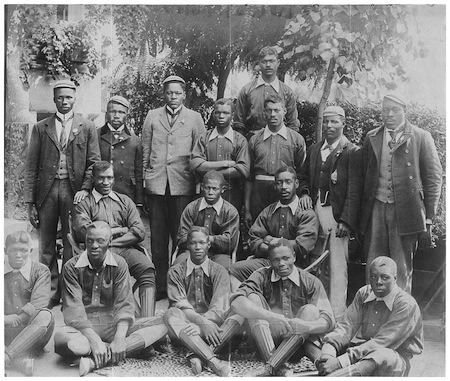
The Orange Free State football team (September 1899)
Over 3.5 Billion people tuned in for the FIFA World Cup this past summer. Very few events can capture the planet’s attention in such a manner, bringing a global audience together for an entire month. Football is the undisputed worldwide sport and a quasi-religion in many countries. Being quite the fanatic myself, rarely a day passes without me indulging in copious helpings of football-related articles or YouTube clips. During one such exploratory session not long ago, I came across the fascinating story of one Arthur Wharton, who is considered to be the very first black professional footballer the world ever saw. His story served as the inspiration for this first blog post of mine, on African Football in the 1800s.
Origins
Not unlike numerous other matters, football was introduced to Africa by Christian missionaries, who first ventured onto the continent in the early 1800s. It comes as no surprise then that South Africa, which saw its first permanent settlements of Europeans before most other African territories, was the first area on the continent where the sport truly blossomed.
Football…or Soccer?
Ah, the great debate. Pardon me while I don my nerd hat and embark on a brief etymological detour. You see, contrary to popular belief, the term “soccer” originated not in America, but in Britain where the modern game was invented.
Football has always existed in various forms, featuring the common element of a ball being kicked to score a goal. In 1863, the current global juggernaut, Association Football (aka the Beautiful Game), was officially born when the Laws of the Game were codified in England. At the time, “rugby football” was another popular version of the sport. Faced with the need for differentiation, the slang “soccer” (abbreviation of aSocciation) progressively emerged, as did “ruggers” for rugby. The term “soccer” has persisted in parts of the globe, notably the US.
So, the next time someone challenges your credentials because you said “soccer”, serve them this piece of history. With a slice of humble pie.
As for myself, I use Football/Futbol/Soccer fairly indiscriminately. In the end, Football is our common language, so who cares what you call it?
Meanwhile, in Africa…
The spread of the game followed a similar pattern across the continent (and the rest of the world for that matter). It would first appear in the major ports, owing to their status of activity hubs, thus the entry point for most missionaries on the continent. As transportation networks grew within a country (trains etc), the sport would then spread progressively to the hinterland.
As previously mentioned, South Africa saw the first real development of the game on African soil. Organized teams such as the Pietermaritzburg County Football Club and the Natal Wasps Football started forming there in the 1880s, eventually culminating in the creation of the SAFA (South African Football Association) in 1892. This was the first organization of its kind on the continent, although predictably for that era, it was reserved to “whites only”. Despite that fact, football was already transcending racial lines, as evidenced by matches at the time between Blacks and Whites in places like the Eastern Cape and Orange Free State (Kroonstad and Jagersfontein). Black South Africans were even known to have played football with British soldiers in besieged towns like Mafeking during the South African War, starting in 1899.
During the first ever foreign tour for a British team, the Corinthian Football Club toured South Africa in 1897, helping to popularize the sport there even more.
Outside of South Africa, the game was starting to take roots as well. In Algeria for instance, French settlers founded the Club Athlétique Liberté d’Oran (CAL Oran) in 1897. It was the first of its kind in the Maghreb.
Overall, the sport was spreading at a faster pace in the British colonies, as they had a more advanced culture of sports at the time than their European counterparts.
So, who exactly is Arthur Wharton?
Long before becoming the first black professional football player in the world, Arthur Wharton was born in 1865 in Jamestown, Gold Coast (now Accra, Ghana) to a Grenadian father and Ghanaian mother. In 1882, Wharton moved from the Gold Coast to England to be a missionary, but on the evidence of his incredible physical ability, he quickly turned to his true love: sports. Wharton was indeed a phenomenal athlete, excelling in football, cricket and rugby. In 1886, he became the first person in England to run the 100-yard dash in 10 seconds, equaling the amateur world record at the AAA (Amateur Athletics Association) championship.
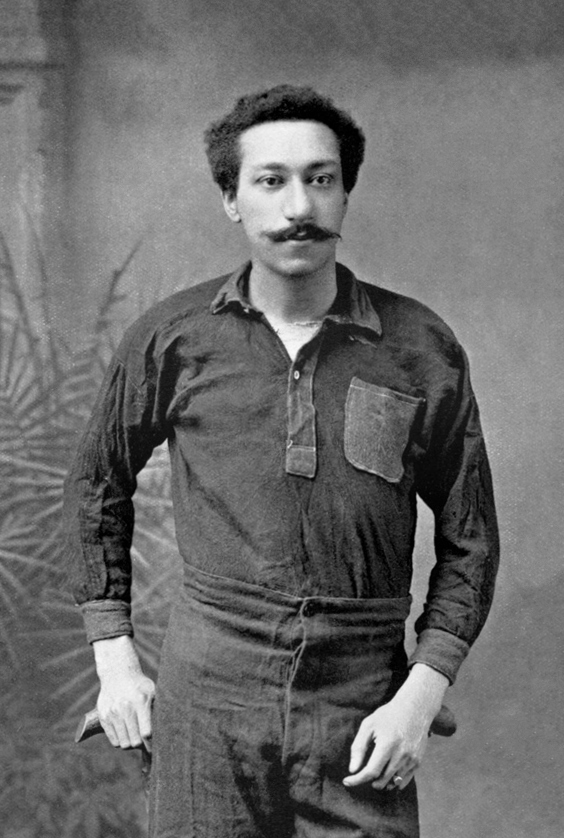
His exploits caught the eye of the amateur football club Darlington, who selected him to play goalkeeper in 1885. He would then move to the more prestigious Preston North End in 1886, playing in the semi-final of the FA (Football Association) Cup the following year against West Bromwich Albion.
Although other black amateur footballers (such as Robert Walker or Andre Watson) predated Wharton, he became the first outright professional black player with his move to Rotherham in 1889. His 5-year stint there marked the pinnacle of his career.
Viewed through a modern lens, it might seem surprising to “waste” the fastest guy on the field in goal, but in Wharton’s days, the goalkeeper was allowed to handle the ball anywhere inside his half. This made speedy goalies like Wharton exceptionally lethal, with the ability to turn defense into attack in the blink of an eye.
Wharton was known for his showboating style, particularly adept at boxing the ball (and sometimes opposing players) in menacing situations. In the end, he played for 7 teams over a 17-year career, retiring at Stockport County at the age of 36.
Sadly, his remarkable achievements didn’t translate to any sustained financial success. The racist environment prevalent in England at the time was an impediment to his assimilation into middle class. Indeed, focus was often drawn to his race to the detriment of his athletic accomplishments. He was referred to as “Othello”, “Colored man” or “Darkie” in the press. Unable to secure fulfilling employment, Wharton ended up as a publican (pub manager) and eventually took a grueling job as a miner. After a long battle with alcoholism, he died virtually penniless in December 1930 in a sanatorium. He was buried in an unmarked grave.
His story largely remained dormant until the 1990s and a book by British author Phil Vasili (The First Black Footballer, Arthur Wharton). More recently, an incredible campaign (involving the likes of musician Stevie Wonder, footballer Rio Ferdinand and others) resulted in the England Football Association building a 16ft statue of Wharton at the National Football Centre in Staffordshire in October 2014. In 2013, he was also inducted into the English Football Hall of Fame. This posthumous recognition was much overdue.

The Orange Free State football team (Basuto XI)
While doing a bit of research for this post, I stumbled upon a most fascinating story, documented by South African sociologist Chris Bolsmann in his brilliant 2010 article: “The 1899 Orange Free State football team tour of Europe: ‘Race’, imperial loyalty and sporting contest”.
As it turns out, in 1899 a team comprised of 16 black South Africans and a few white officials landed in England, for a tour that would take them on subsequent stops to France, Ireland, Scotland and Wales. This was the first ever African football team to play abroad, recording a total of 49 games over the course of 4-6 months.
Though vaunted for their physical abilities, their lack of organization meant that they were never considered serious opposition by the English. As we saw with Arthur Wharton, professional football amongst Blacks was in its infancy, so these players were all amateurs ranging from grocers (like the captain Twayi) to carpenters and tailors. Most of them were simply out of their depth, save for the goalkeeper Adolf who regularly drew rave reviews and speculations of a possible (yet never realized) professional contract in Europe. Complicating matters further was the fact that Africans had never played on turf before this tour. The games followed a similar pattern: The English would jump out to a comfortable lead, and then were content goofing around (playing with no goalie, for instance).
For the British public at large, the Africans were quite the novelty, and popular reaction ranged from gleeful curiosity from the locals to abject racism in the press. The dark reality of these colonial times meant that there was always going to be underpinnings of racial prejudice, with some people extrapolating football dominance to overall superiority. Some saw the very act of an African team lining up against the almighty British as sacrilegious. Nevertheless, the tour was a hit with the locals and the team regularly drew thousands of spectators.
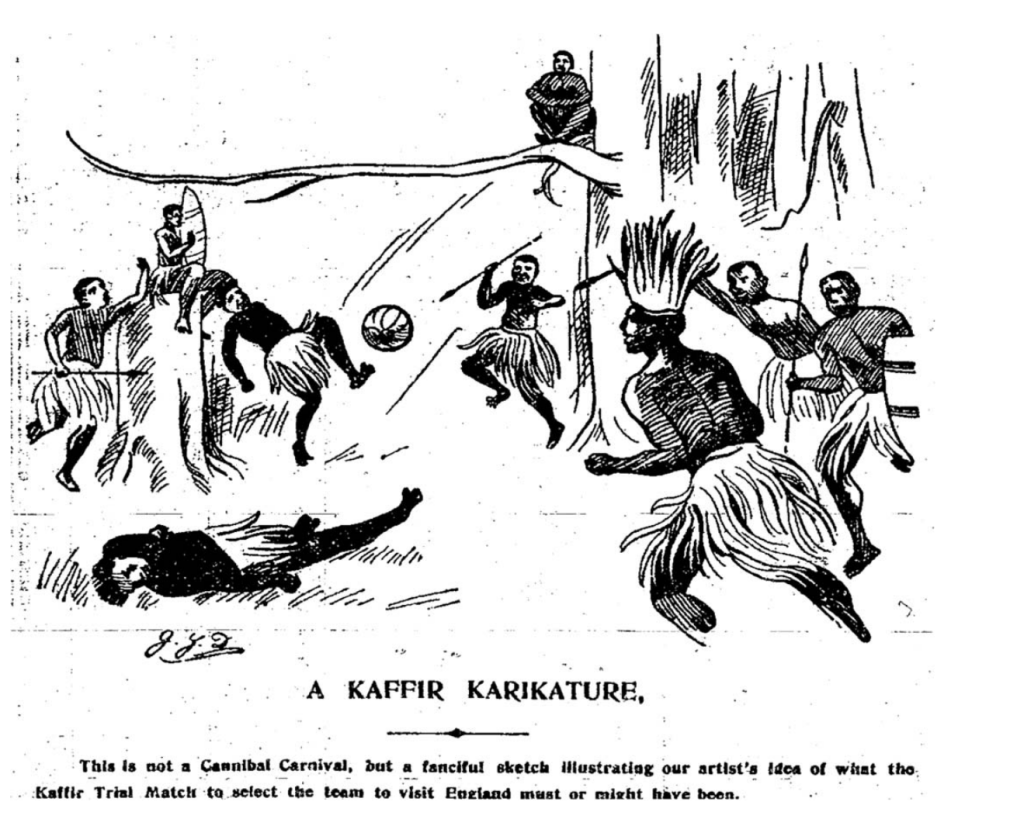
In the end, their solitary victory on the tour came against Sporting Club Tourcoing (3-1) in France. The fact that the Africans managed to defeat their French counterparts after their dismal showing in England is a testament to just how far ahead of everyone the British teams were at the time.
The team returned home to no fanfare, and little is known about their subsequent adventures, other than Joseph Twayi’s later involvement in politics: he who would go on to become Treasurer of the South African Native National Congress (precursor to Nelson Mandela’s party, the African National Congress). Regardless, this is a remarkable piece of football history and the OFS team’s contribution to globalizing Football is undeniable.
In Closing
So, there you have it. Both on and off the continent, Africans started leaving their imprint on football in the 1800s, a process that would accelerate in the following century. We’ll continue exploring this history in future posts.
As for Mr Wharton: hats off to you, good sir. If only you could see what you helped create. A direct thread weaves throughout history, linking you to legends like Pele and Eusebio.
Sources
- https://blog.oxforddictionaries.com/2014/06/20/first-rule-football-dont-call-soccer/
- “Laduma!: Soccer, Politics and Society in South Africa, from its Origins to 2010” by Peter Alegi
- http://ukznpress.bookslive.co.za/blog/2010/06/10/podcast-peter-alegi-on-south-africas-footballing-history-plus-alegi-contributes-to-new-york-times-feature/
- https://en.wikipedia.org/wiki/Football_in_Algeria
- http://arthurwharton.info/wp-content/uploads/2013/11/Revival.pdf
- https://en.wikipedia.org/wiki/Arthur_Wharton
- https://www.livingnorth.com/northeast/people-places/forgotten-footballer-arthur-wharton http://www.bbc.co.uk/tyne/roots/2003/10/arthur_wharton.shtml
- Chris Bolsmann (2011) The 1899 Orange Free State football team tour of Europe: ‘Race’, imperial loyalty and sporting contest, The International Journal of the History of Sport, 28:1, 81-97, DOI: 10.1080/09523367.2011.525307
- http://www.thecelticwiki.com/page/1899-09-21%3A+Celtic+2-0+The+Kaffirs%2C+Friendly
- http://www.rsssf.com/tableso/oranje-england9900.html
 African History Today
Leave a comment